
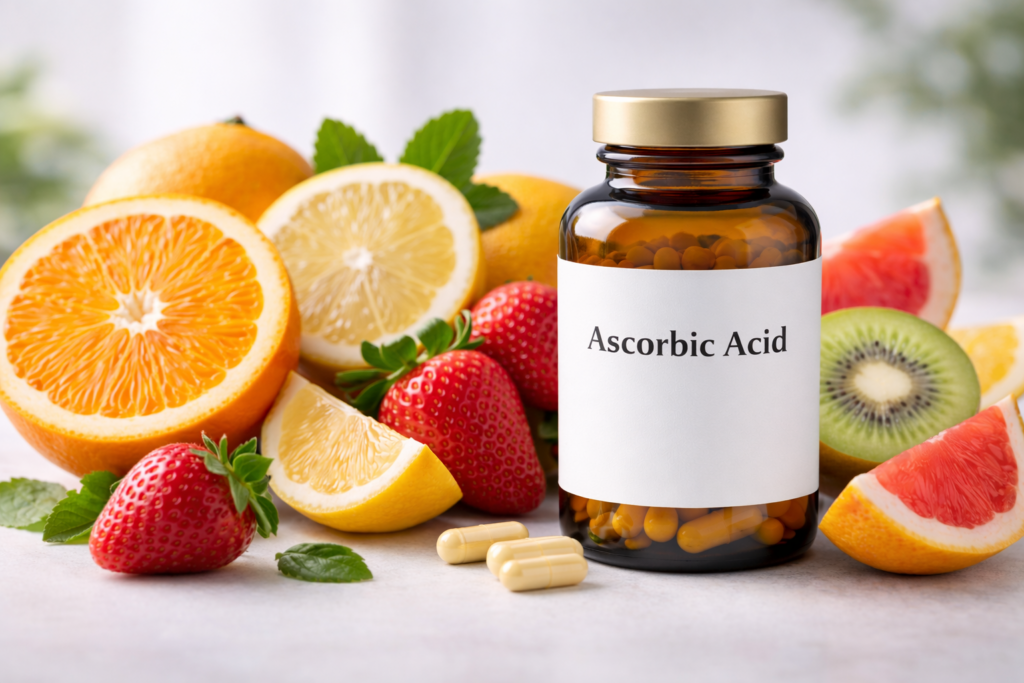
If you searched “vitamin c vs ascorbic acid,” you’re probably seeing two loud messages at the same time. One side says they’re basically the same thing. The other side says one is “incomplete” or missing something important. The truth is simpler and more useful: the chemistry is well-defined, and the real-world experience often comes down to form, dose, and tolerance.
Big picture: In nutrition science, “vitamin C” refers to a specific molecule (and its closely related oxidized partner), which is why so many credible references use “vitamin C” and “ascorbic acid” almost interchangeably. At the same time, people don’t experience nutrients as isolated chemistry in a vacuum. Foods contain many compounds besides vitamin C, and supplements vary in acidity, fillers, dose, and how they fit into your day.
Why this article is different: You’ll get a grounded definition first, then the practical stuff that drives most “it feels different” reports: absorption limits, label language, and what to do if standard tablets bother your stomach.
Key Takeaways
- Vitamin C is defined as L-ascorbic acid, and it also cycles through an oxidized form during normal biology. [1]
- Human studies generally find similar vitamin C bioavailability from supplements versus common food sources when doses are matched. [1] [3] [4]
- At physiological pH, most vitamin C exists as “ascorbate,” which is a normal acid-base form of the same compound. [7]
- Many “differences” people notice come from dose size, acidity, mineral salts, timing with food, and individual sensitivity. [1] [2] [5]
- Whole foods can be a smart default because they deliver vitamin C plus other nutrients and plant compounds, even when vitamin C absorption itself is similar. [2] [4]
Vitamin C vs ascorbic acid: what is actually different
Quick answer: In standard nutrition language, vitamin C is the nutrient name for L-ascorbic acid, a water-soluble vitamin that humans must obtain from food or supplements. [1] [2] A lot of the confusion comes from labels, marketing terms, and the fact that vitamin C shifts forms depending on the chemistry environment inside and outside the body. [7]
Here’s the cleanest way to hold the concept in your head without getting pulled into extremes.
Compact text chart: what people mean when they say “vitamin C”
- “Vitamin C” (nutrition term): the vitamin activity tied to L-ascorbic acid, plus its normal oxidized partner during recycling. [1]
- “Ascorbic acid” (chemistry term): the acidic form of the same molecule. [7]
- “Ascorbate” (chemistry term): the ionized form that dominates at near-neutral pH, including in blood. [7]
- “Food-based vitamin C” (diet term): vitamin C plus the broader food matrix from fruits and vegetables. [2] [4]
A helpful quote to anchor the definition:
“Vitamin C, also known as L-ascorbic acid, is a water-soluble vitamin.” [1]
So where does the lived experience fit in? People are not imagining things when one form feels “harsher” than another. But the most evidence-consistent explanation is usually not “different vitamin C,” it’s “different delivery.” Dose size, acidity, added minerals, and timing can change tolerance and bathroom outcomes fast. [1] [2] [5]
Vitamin C definition in nutrition science
Definition: Vitamin C is an essential nutrient for humans, required for key biosynthetic reactions and antioxidant roles. It is needed for collagen formation, it supports certain neurotransmitter pathways, and it improves absorption of non-heme iron (the type found in many plant foods). [1] [2] [8]
Oxidation and recycling: Vitamin C does its job largely because it can donate electrons. In the process, it can shift into oxidized forms and then be recycled back, which is part of normal physiology. One commonly discussed oxidized partner is dehydroascorbic acid, which can enter cells through some glucose transport routes and then be reduced back internally. [1] [7]
Why this matters for labels: Once you know that “vitamin C” is the nutrient name and “ascorbic acid/ascorbate” are chemistry names for the same compound in different acid-base forms, label language becomes less mysterious. [2] [7]
Table: vitamin C terms you will see, translated into plain English
| Label term you see | What it usually means | Practical takeaway |
|---|---|---|
| Vitamin C | The nutrient amount (often in mg) | Look at mg per serving and serving size. [2] |
| Ascorbic acid | The acidic form of vitamin C | Can be more “tangy” and bothers some stomachs at higher doses. [2] [5] |
| Sodium ascorbate / calcium ascorbate | Mineral salt forms (buffered) | Often less acidic, but adds a mineral load. [2] |
| Ascorbate | The dominant form at physiological pH | This is normal chemistry, not a different vitamin. [7] |
| With bioflavonoids | Vitamin C plus plant compounds | Research has not shown one form is “better” overall. [2] [4] |
Mini-summary: The definition is settled enough to be useful: vitamin C is the nutrient, and ascorbic acid is the primary named molecule associated with that vitamin activity. Your body’s experience depends far more on form and dose than on a “different vitamin C.” [1] [2] [7]
Absorption and what your blood levels can and cannot do
A lot of supplement debates ignore the boring part that matters most: intestinal transport has limits.
Dose-dependent absorption: Moderate intakes absorb well, but the percentage absorbed drops as you push doses higher. In a commonly cited range, about 70% to 90% is absorbed at moderate intakes (roughly 30 to 180 mg/day), while absorption can fall below 50% at doses above 1 gram/day. [1] This is one reason why “more” often turns into “more expensive urine,” and why some people experience GI upset at high single doses. [1] [5]
Compact text chart: dose vs absorption trend
- 30 to 180 mg/day: high fractional absorption (about 70% to 90%) [1]
- Above 1,000 mg/day: lower fractional absorption (less than 50%) [1]
- Practical result: smaller split doses can be easier to tolerate than one large dose [1] [8]
Plasma saturation: Oral vitamin C raises blood levels, but the body regulates plasma and tissue concentrations tightly. Even when you take large oral doses, there is a ceiling effect compared with ordinary food intakes, and excess is excreted. [1]
Food vs supplement bioavailability: When researchers match doses and measure blood and tissue markers over time, steady-state human studies generally show little or no meaningful difference between vitamin C from common foods and vitamin C tablets. [1] [3] [4] For example, a randomized human study comparing a matched daily dose from fruit versus a tablet found comparable bioavailability across multiple compartments. [3]
Mini-summary: If your goal is “raise vitamin C status,” consistency beats megadosing. Split doses and tolerable forms are often the difference between “I tried it once” and “this actually works for me.” [1] [5] [8]
Whole-food sources and the food matrix
This is the most reasonable place to talk about “whole vitamin C” without drifting into inaccurate chemistry.
Whole foods bring more than vitamin C: Fruits and vegetables deliver vitamin C alongside other nutrients and plant compounds. Even if these compounds do not dramatically change vitamin C absorption in humans, they can have independent value for overall health patterns. [2] [4]
What the best evidence supports: A detailed review of animal and human research notes that while animal models sometimes show differences, human steady-state studies generally do not show differences in vitamin C bioavailability between synthetic and food-derived sources. [4] That same review also argues that whole foods are still preferable as a default because they come packaged with additional nutrients and phytochemicals that contribute to health beyond vitamin C alone. [4]
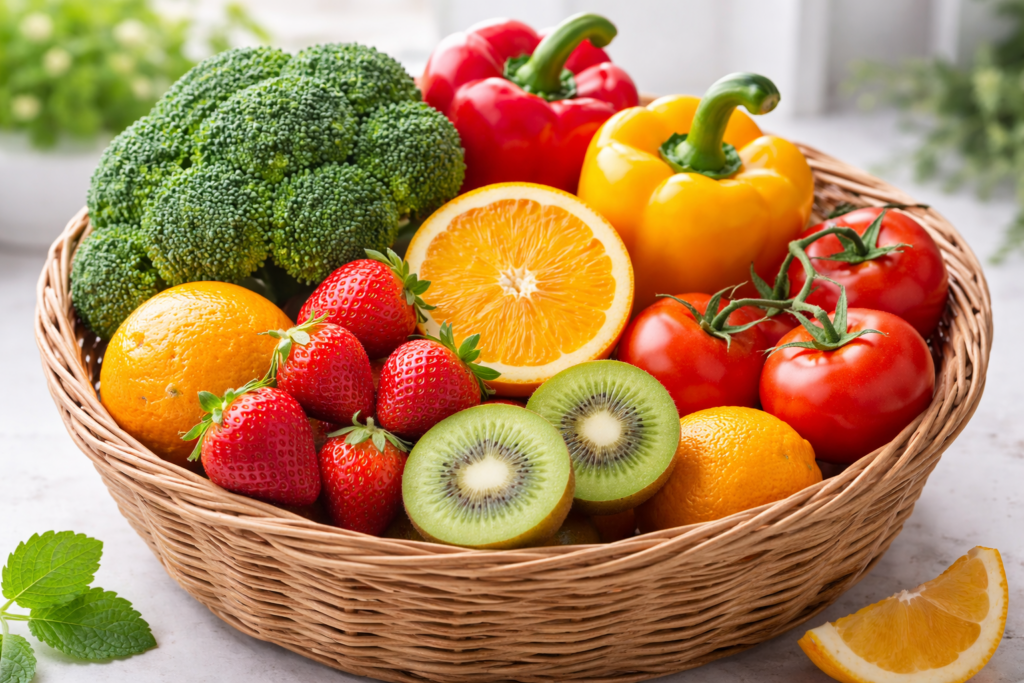
Most practical “whole food vitamin c” list:
- Citrus fruits and juices
- Kiwifruit
- Bell peppers (red and green)
- Broccoli
- Strawberries
- Tomatoes
- Potatoes
These are commonly cited examples of vitamin C-rich foods. [2]
Clinical observation, framed correctly: Some clinicians and individuals report better tolerance or a better subjective experience with food-first approaches or certain food-based extracts. That can be real, even when the vitamin C molecule absorbed is the same. The “why” often traces back to dose size, timing with meals, overall diet quality, and sensitivity to acidity or additives rather than a different definition of vitamin C. [2] [4] [5]
Supplement label decoding and common forms
This section is here so you can look at a bottle and immediately know what you’re buying.
The common baseline: Most supplements provide vitamin C in the form of ascorbic acid, but other forms exist, including mineral ascorbates and products combined with bioflavonoids. Research summaries for consumers report that no form has been shown to be better than other forms overall. [2] Health professional summaries also note that the typical supplemental ascorbic acid has bioavailability equivalent to the ascorbic acid naturally present in foods. [1]
Ascorbic acid vs ascorbate, in plain terms:
- In an acidic environment, “ascorbic acid” is the common way to name it. [7]
- At physiological pH, the dominant form is the ascorbate monoanion, which is why scientific writing often uses “ascorbate” when talking about what’s happening inside the body. [7]
That’s not a different vitamin. It’s the same vitamin C chemistry behaving normally in different pH conditions. [7]
Table: common supplement forms and who they may fit
| Form | What it is | Pros | Watch-outs | Often a good fit for |
|---|---|---|---|---|
| Ascorbic acid | Standard vitamin C | Affordable, widely available | Can trigger heartburn or loose stools at higher doses | Most people starting out [2] [5] |
| Mineral ascorbates | “Buffered” salts | Often less acidic | Adds sodium, calcium, etc depending on type | People sensitive to acidity (check minerals) [2] |
| Timed-release | Slower release formats | Convenience | Some data suggest reduced absorption in certain designs | People who cannot take multiple doses (individual response varies) [1] |
| Liposomal | Encapsulated delivery | May modestly change blood levels in some contexts | Costs more, fewer long-term comparisons | People experimenting with tolerance or convenience [5] |
Mini-summary: For most goals, the “best” supplement is the one you can take consistently without GI issues. That’s usually a choice between standard ascorbic acid and a buffered mineral ascorbate, adjusted by dose size and timing. [2] [5]
Why tolerance can vary from person to person
This is where the “clinically it feels different” reports usually land, and you can discuss it without claiming different vitamins.
Acidity and heartburn: Some people experience heartburn, nausea, or stomach upset with oral vitamin C, especially at higher doses. Acidity can be one contributor, and switching forms or taking it with food may help some individuals. [5] [2]
Osmotic effects and loose stools: Unabsorbed vitamin C can draw water into the gut and contribute to diarrhea or cramping. This is a common reason tolerable upper limits exist and why split dosing helps. [1] [2]
Dose size matters more than brand claims: If you take 1,000 mg once, your body’s fractional absorption is lower than at modest intakes, and your GI tract is more likely to complain. If you take 250 mg twice daily, many people tolerate it better even though the daily total is similar. [1] [8]
Additives and format: Chewables, gummies, and flavored powders can add acids, sugar alcohols, or other ingredients that drive symptoms that get blamed on “ascorbic acid” when the real culprit is the delivery format. A capsule can feel completely different than a fizzy drink mix at the same dose, even though the vitamin C is similar.
Mini-summary: When someone says “ascorbic acid didn’t work for me,” the highest-yield follow-up is almost always: what dose, what form, with food or not, and what else was in the product? [1] [2] [5]
Dosing and safety basics for U.S. adults
This is not medical advice, but it gives you evidence-based guardrails.
Recommended intakes: Typical recommended daily amounts for adults are often listed around 90 mg/day for men and 75 mg/day for women, with higher needs in smokers. [1] [2]
Upper limit: Many U.S.-used references list an upper limit of 2,000 mg/day for adults from all sources. Above this level, side effects like diarrhea, nausea, and cramping become more likely. [1] [2] Long-term use above 2,000 mg/day is also cautioned in clinical summaries. [5]
Kidney stones and special risk: Some summaries note possible kidney stone risk in susceptible individuals at higher supplemental doses, and the broader evidence can be mixed depending on the population and the method used. If you have a history of kidney stones or kidney disease, this is worth discussing with a clinician before high-dose use. [1] [5] [8]
Iron overload conditions: Vitamin C increases absorption of non-heme iron. That can be helpful for many diets, but it can be a concern for iron overload conditions. This is another situation where high-dose supplementation should be clinician-guided. [1] [2] [5] [8]
Medication and testing interactions: Vitamin C can interact with certain therapies and can interfere with some lab tests, particularly at high supplemental intakes. If you’re in active treatment for a serious condition or scheduling lab work, it’s smart to disclose supplement use. [1] [2] [5]
Safety checklist (quick scan)
- Start low (100 to 250 mg/day) and increase only if you tolerate it well. [1] [8]
- Split doses if you want higher totals (for example, 250 mg twice daily). [1] [8]
- Avoid high doses if you have kidney stone risk unless clinician-guided. [1] [5] [8]
- Be cautious with high doses if you have iron overload risk. [1] [2] [5]
- Pause and ask a clinician if you’re on complex medications or active cancer therapy. [2] [5]
How to choose a form that fits your goals
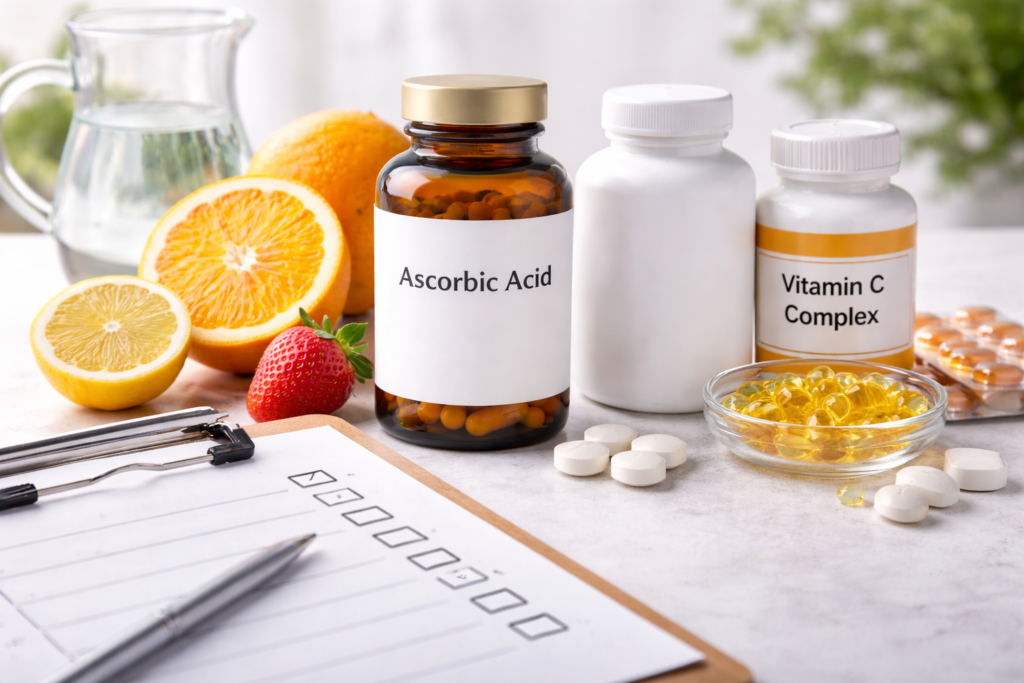
Use this section as a decision tool, not a debate club.
Goal: general nutrition insurance
Best starting move: prioritize fruits and vegetables, then add a modest supplement only if needed. Whole foods improve overall nutrient density, and supplements can fill gaps. [2] [4]
Goal: you want a simple supplement that “just works”
Try: 250 to 500 mg/day as a standard tablet or capsule, split if needed. [1] [8]
Goal: you get heartburn or stomach upset
Try: a buffered mineral ascorbate or take the supplement with food, and reduce single-dose size. [2] [5]
Goal: you want “natural vitamin c”
Reality check: Human data generally show similar bioavailability for food-derived versus synthetic vitamin C at matched doses. Choose food-based products for dietary preference and added plant compounds, not because the vitamin C molecule is different. [3] [4]
Table: simple selection guide
| If this is you | Best first choice | Next tweak if needed |
|---|---|---|
| New to supplements | 100 to 250 mg/day standard form | Split dosing, take with food [1] [2] |
| Sensitive stomach | Buffered mineral ascorbate | Lower dose per serving, avoid acidic drink mixes [2] [5] |
| Food-first approach | Increase vitamin C-rich foods | Add small supplement only if intake is low [2] [4] |
| Chasing high doses | Reconsider the goal | Split doses, stay within upper limit unless clinician-guided [1] [5] |
Conclusion
The most useful way to settle the “vitamin C vs ascorbic acid” confusion is to separate chemistry from delivery. In standard nutrition science, vitamin C is defined around L-ascorbic acid and the normal forms it cycles through in the body. [1] [7] That means ascorbic acid is not “just part” of vitamin C in the way some claims suggest.
At the same time, people’s experiences can differ, and that’s worth taking seriously. Those differences usually trace back to dose size, acidity, mineral salts, additives, and timing, not a fundamentally different vitamin. [1] [2] [5]
If you want the simplest “best choice” rule: start with food, use a modest supplement only if needed, and choose the form you can tolerate consistently. That’s the approach that aligns with what human bioavailability research shows and what day-to-day adherence actually requires. [2] [4]
References
Health Fact Sheets and Medical Overviews
[1] “Vitamin C: Fact Sheet for Health Professionals,” nutrient overview and dosing tables, 2025.
[2] “Vitamin C: Fact Sheet for Consumers,” guidance on forms, foods, and upper limits, 2021.
[5] “Vitamin C,” overview, safety, and side effects, 2025.
[6] “Ascorbic Acid (Vitamin C): Drug Information,” indications and deficiency context, 2024.
Peer-Reviewed Human Research
[3] “A randomized steady-state bioavailability study of synthetic versus natural (kiwifruit-derived) vitamin C,” randomized controlled trial abstract, 2013.
[4] “Synthetic or Food-Derived Vitamin C: Are They Equally Bioavailable?,” narrative review of animal and human studies, 2013.
[7] “Stability of aqueous solutions of ascorbate for basic research and for intravenous administration,” acid-base speciation and dominant physiological form discussion, 2023.
Clinical Reference Texts
[8] “Vitamin C (Ascorbic Acid),” clinical overview including deficiency and treatment dosing, 2023.